Library Trustees Finish Bylaws Rewrite Review
The Londonderry Library Board of Trustees worked through a near-final rewrite of its bylaws on July 22, taking no formal votes.
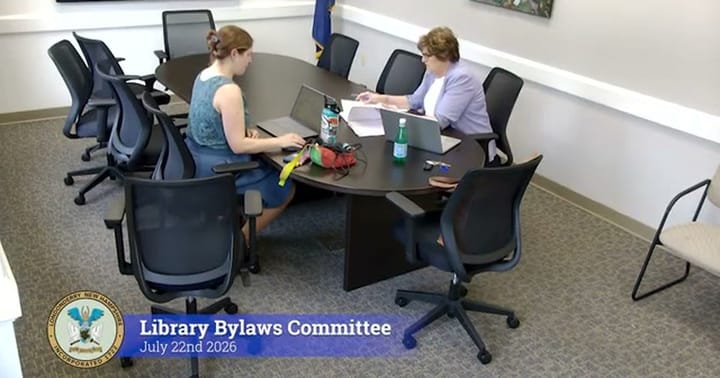
Library Board · Meeting of July 22, 2026
LONDONDERRY — The Londonderry Library Board of Trustees worked through a near-final rewrite of its bylaws on July 22, taking no formal votes. Trustee Erica, who compiled the tracked edits, told the board an abstention "removes the trustee's vote from the final vote count, but does not change the number of votes required" to pass a motion. Trustees found RSA 669:75 directs library vacancies to be filled by a town's board of selectmen, a body Londonderry lacks, leaving what one member called "a weird, ambiguous place"; the board plans instead to interview candidates and recommend appointees to the Town Council.
Trustees learned the board's attorney, Hannah, left her firm and moved out of state. The board scheduled an August 5 work session and will present the finished bylaws at its August 10 or August 20 meeting.
In the full story:
- Who Was There
- Organizations And Documents Referenced
- The complete report — 2,887 words
Source: the Library Board meeting of July 22, 2026, reported from the official video recording and transcript.
Checked against the record: before publication this article was automatically compared with the meeting transcript.
The Full Article
Call to Order and Public Comment
The board's presiding trustee called the meeting to order at 6 p.m. with the Pledge of Allegiance. No one appeared for public comment at the opening of the meeting or at its close. The session was structured as a working review of a tracked-changes draft of the board's bylaws, a document one trustee referred to throughout as the "Bylaws Draft," with members comparing a clean copy against a redlined copy page by page.
Abstention Language Under Article 4
Background and stakes: The board had previously discussed, but not finalized, how abstentions should be treated procedurally. The question of whether an abstaining member's vote still counts toward the threshold needed to pass a motion had apparently been a point of informal confusion on the board.
The question before the body: Whether the bylaws should explain the mechanics of abstention, and whether to retain language justifying why a trustee might abstain.
Substantive content: Citing Robert's Rules of Order, the board confirmed that an abstention removes a trustee's vote from the final count but does not reduce the number of affirmative votes a motion needs. Using a seven-member board as an example, trustees worked through the math: if the board needs four yes votes to pass a motion and one member abstains, the motion still needs four yes votes out of the remaining six cast. The new Article 4, Section 1, subsection 1.2 language reads, in the trustee's words: "Under Robert's Rules of Order, board members have the right to abstain from a vote. An abstention removes the trustee's vote from the final vote count, but does not change the number of votes required for the motion and question to pass based on the number of trustees present."
The deliberation: Erica, the trustee who has been compiling edits between meetings, told the board she had removed language the board previously drafted explaining why a member might abstain, because Robert's Rules does not require trustees to state a reason. A second trustee pushed back gently, saying residents would likely ask about the change regardless: "I think you need to put a footnote there because people are going to ask us about that." Erica agreed to add a source citation to the footnote rather than restore the original explanatory language.
Procedural steps and outcome: No vote was taken; the board reached informal consensus to keep the abstention mechanics language and add a sourcing footnote. Erica said she would locate the specific citation before the next meeting.
Implications and what is next: The clarified abstention language removes ambiguity about vote thresholds going into future board votes, including any future vacancy or appointment votes.
Special Meeting Notice and the 24-Hour Question
Background and stakes: The current bylaws contained a single run-on sentence describing how special meetings may be called, which the board found unclear.
The question before the body: Whether to simplify the sentence describing who may call a special meeting, and whether to cite the specific state statute governing 24-hour notice.
Substantive content: The redrafted language reads: "Special meetings may be called by the chairperson, or at the request of four members of the board, for the purpose of transaction of business as stated in the call for the meeting. Only 24 hours notice is required. The chair may request another trustee to contact the board for this purpose." Trustees agreed the 24-hour notice period should be tied to a specific RSA citation, though neither trustee had the exact statute number in hand during the meeting; it was left as a comment in the draft for follow-up.
The deliberation: The exchange was brief and procedural, with one trustee asking, "Do we want to point to that RSA on the 24 hours notice or not?" and the other agreeing it was "a good idea," without resolving which statute applies that night.
Procedural steps and outcome: No vote; the citation remains an open action item flagged in the draft document.
Implications and what is next: The simplified sentence is ready for the final bylaws presentation; the statute citation needs to be filled in before that presentation.
Library Director Spending Authority and the Purchasing Policy
Background and stakes: The current bylaws cap the library director's discretionary spending, outside the normal budget, at $500 in a given month. A separate purchasing policy intended to govern purchasing procedures more broadly has been in development and was presented to the board at its June 4 meeting, where it was sent back to committee.
The question before the body: Whether to rewrite the bylaws now to reference the forthcoming purchasing policy rather than retain a fixed dollar figure.
Substantive content: The revised bylaws language reads that the library director "may expend funds outside of the normal budget in accordance with the Board of Trustees purchasing policy," while retaining existing language requiring board notification in the event of an emergency expenditure. Trustees confirmed the purchasing policy, once adopted, is expected to raise the $500 threshold, though the exact new figure was not stated at this meeting.
The deliberation: One trustee asked whether the board had already approved the purchasing policy or whether it was still pending; the answer was that it remains pending. "It was presented and discussed" at the June 4 meeting, one trustee said, consulting the minutes, and the committee was asked to confirm "we had everything ready to go" rather than make major edits.
Procedural steps and outcome: No vote on the bylaws language itself; trustees agreed the bylaws reference to the purchasing policy is ready pending the policy's own adoption. One trustee said she would ask during committee reports later in the meeting when the purchasing committee expects to present a final version to the full board.
Implications and what is next: The bylaws cannot be finalized independent of the purchasing policy vote, since the dollar figure governing the director's discretionary spending depends on that separate document.
Officer Elections Housekeeping
Background and stakes: The bylaws section on electing board officers contained redundant language describing the timing of the first trustee meeting following town elections.
The question before the body: Whether to simplify that language by cross-referencing the special-meeting provisions discussed earlier in Article 3.
Substantive content: The board agreed to rewrite Article 1, Section 3.1 to state that officer elections occur at a special trustee meeting following the town election, as outlined in Article 3, Section 3.01, where the special-meeting calling procedure is specified, rather than repeating the full description.
Procedural steps and outcome: No vote; the change was treated as a grammar and organization fix rather than a substantive policy change.
Membership, Vacancies and Alternate Trustees
Background and stakes: The board had previously flagged, in an earlier revision cycle, that it needed to outline a process for filling vacancies and for creating alternate trustee positions, including checking the town charter for any governing language.
The question before the body: What process the board should adopt for recruiting, vetting and filling vacant or alternate trustee seats, given that the town charter is silent on the subject.
Substantive content: A staff member identified as Donna confirmed, after being consulted directly during the meeting, that the Londonderry town charter contains no library-specific vacancy procedure. Erica then read two state statutes into the record: RSA 202-A:10, which states that library board vacancies "shall be filled as provided in RSA 669:75," and separately allows a library board to recommend up to three alternate members to the appointing authority; and RSA 669:75, which directs that vacancies in offices including library trustee, where no other method is provided by town vote, "shall be filled by appointment made by the board of selectmen." Because Londonderry operates under a Town Council rather than a board of selectmen, trustees said the statute leaves the town "in a weird, ambiguous place."
The deliberation: Trustees converged on a proposed process: advertise an opening, collect resumes and letters of interest, interview candidates in a public meeting, and forward a recommendation to the Town Council, which would make the formal appointment. One trustee drew a direct comparison: "You know, just like they do for the town council, right? All in a public meeting." Another trustee cited a prior difficulty, saying that during an earlier vacancy process "a year and a half ago," she received a candidate's resume "at nine o'clock in the morning" the same day the board was expected to vote, and said the new process needs defined windows: a fixed advertising period, a fixed review period, a public interview, and then a recommendation to the council. Trustees agreed the posting period should mirror the town's standard two-week window rather than create a separate timeline.
Procedural steps and outcome: No vote. Trustees agreed informally that the recruitment and alternate-seat process should be combined into a single procedure in the bylaws, but that the board as a whole still needs to decide, as a policy matter, whether it wants alternate trustee seats at all before that procedure becomes operative. One trustee said she would call a staff member identified as Kirsten to confirm logistics for the next vacancy posting.
Implications and what is next: Until the full board votes on whether to create alternate seats, the vacancy-filling procedure in the bylaws will describe a process without triggering alternates unless the board separately adopts them.
Officer Attendance, Removal and Trustee Obligations
Background and stakes: The current bylaws allow removal of a board officer by two-thirds vote for gross negligence, failure or refusal to perform duties, or missing three consecutive meetings, but the board had identified a gap: no language addresses what happens when a non-officer trustee cannot fulfill the duties of the office, including extended illness or leave.
The question before the body: Whether and how to add language addressing non-officer trustee obligations and potential incapacity, beyond the existing officer-removal provision.
Substantive content: The existing Article 1, Section 3.7 officer-removal language requires notice at the public meeting preceding the removal vote. Trustees discussed adding separate language under Article 2's description of the board's governing duties, reminding elected trustees that they are expected to attend meetings and participate fully, framed as a reminder of elected-office responsibility rather than a removal mechanism.
The deliberation: "Because that's an appropriate reminder of the responsibility of an elected office," one trustee said, and the other agreed: "I like that one." The board also agreed to call the New Hampshire Municipal Association for guidance on best practices when a trustee stops attending altogether, a gap the current bylaws do not address for non-officers.
Procedural steps and outcome: No vote; the language addition was left as a drafting task, tied to the outcome of the alternates discussion and the Municipal Association call.
Implications and what is next: The final bylaws presentation may still be missing finished language on trustee incapacity pending that outside guidance.
Remote Meeting Attendance
Background and stakes: State law does not allow a board to prohibit remote attendance outright, but requires a defined process, which the current bylaws draft does not yet contain.
The question before the body: What procedural requirements the bylaws should set for a trustee attending remotely.
Substantive content: Trustees identified two required elements based on their understanding of the applicable rules: the full board must vote to allow a given instance of remote participation, and all participants, whether in the room or remote, must be able to hear one another, with the remote trustee required to identify who else is present with them. One trustee said she would call the New Hampshire Municipal Association "and get more clarity on that" before finalizing bylaws language.
Procedural steps and outcome: No vote; remote-attendance language remains undrafted and was identified, along with trustee-incapacity language, as one of two outstanding items before the bylaws can be finalized.
Trustee's Privilege and Employee Discharge Authority
Background and stakes: The board previously drafted, but had not finalized, a provision letting a trustee flag feeling insufficiently informed on an item before voting, and separately had draft language shifting authority to discharge library employees from the trustees to the library director.
The question before the body: Whether to retain the "trustee's privilege" language as drafted, and whether to relocate employee-discharge authority out of the trustees' duties section into the library director's duties section.
Substantive content: The retained privilege language, under Article 3, Section 1.4, reads: "If a trustee feels insufficiently informed on a given topic or agenda item to be able to vote on that item, the trustee is entitled to raise that issue with the board. The board may then discuss the available information and come to a consensus on whether to proceed with the topic or delay the vote to the next meeting." On employee discharge, the current bylaws state trustees "in consultation with the library director" may discharge an employee; a proposed revision would instead give that authority to the library director, except in cases of urgency or public safety, when the director must notify the board before dismissal.
The deliberation: Trustees agreed the privilege language should not function as a veto: "It is, but it can't hold up a vote," one trustee said, and the other clarified the intent was to be "clear that it might not change the outcome." On employee discharge, one trustee raised a concrete concern about being blindsided: "I don't want to pick up the newspaper and read that so-and-so has been discharged from their duties the next day in the newspaper without knowing it." The board decided, for now, to leave the discharge provision under the trustees' duties and obligations section rather than move it to the library director's section, while preserving the substance of the change, and noted the board could relocate it later if it wished.
Procedural steps and outcome: No vote on either provision; both were treated as settled drafting decisions pending the full board's review. Trustees also caught and flagged a duplicate section-numbering error (two sections both labeled 2.4) for correction before the next draft.
Implications and what is next: Both provisions are ready for inclusion in the near-final draft to be presented in August.
Other Housekeeping Items
Trustees agreed to add a parenthetical clarifying that money from fines and payments for lost or damaged library materials is held in a revolving fund informally called "the book fund." They also removed language requiring the board secretary to assist with the annual audit report filed with the attorney general's office, concluding after discussion that the responsibility belongs to the treasurer and library director or assistant director, not the secretary, and agreed the board could restore the secretary's role later if it chooses.
Legal Counsel and Scheduling
Trustees were told the attorney who has represented the board, identified only as Hannah, has left her law firm and moved out of state, and that the board needs a new point of contact. One trustee, who had been tasked earlier with pricing legal representation, said she still intends to do so now that the prior arrangement has lapsed. The board agreed to hold one more bylaws work session on August 5 at 6 p.m. and to present the finished draft at either the board's August 10 or August 20 meeting, with the exact date to depend on what else is on the agenda as the library's reopening approaches. Before adjourning, one trustee noted the evening's broader agenda would include an update from a person identified as Bob on structuring maintenance trust funds, a separate item not covered in the bylaws discussion.
Library Board trustees present, unnamed in available sources except for the trustee identified in discussion as Erica, who led the bylaws markup; the number of trustees present and any absences were not stated in the transcript and no roster or minutes were supplied for this meeting.
A staff member identified as Donna was consulted during the meeting regarding the town charter; her title was not stated in the transcript.
No members of the public spoke during the two public-comment periods.
No outside applicants, consultants or attorneys attended; the board's outside attorney, identified as Hannah, was discussed in absentia regarding her departure from her law firm.
RSA 202-A:10 — state law cited by trustees stating library board vacancies are filled per RSA 669:75, and allowing a library board to recommend up to three alternate trustees.
RSA 669:75 — state law cited by trustees directing that vacancies in offices including library trustee be filled by a town's board of selectmen; discussed as ambiguous for Londonderry, which has a Town Council instead.
Londonderry Town Charter — checked by trustees, with help from a staff member identified as Donna, and found to contain no library-specific vacancy or alternate-trustee procedure.
Robert's Rules of Order — cited as governing authority for the board's treatment of abstentions.
New Hampshire Municipal Association — an outside body trustees said they plan to call for guidance on remote-attendance procedure and on handling trustees who stop attending meetings.
Library Board purchasing policy (draft) — presented to the board June 4, sent back to committee to confirm readiness, cited as the future authority governing the library director's discretionary spending limit referenced in the bylaws.
Bylaws Draft — the primary document under revision throughout the meeting, tracked with redline changes against the board's currently enforced bylaws.
Share this story
Know someone in Londonderry who follows town government? Share Townbrief Londonderry: they can sign up free.