Budget Committee unanimously adopts new bylaws
The Londonderry Budget Committee voted unanimously to adopt new bylaws and heard Town Manager Shaun Mulholland project a $5.5 million annual net fiscal benefit from the proposed 1,028-unit Brookview Hollow development.
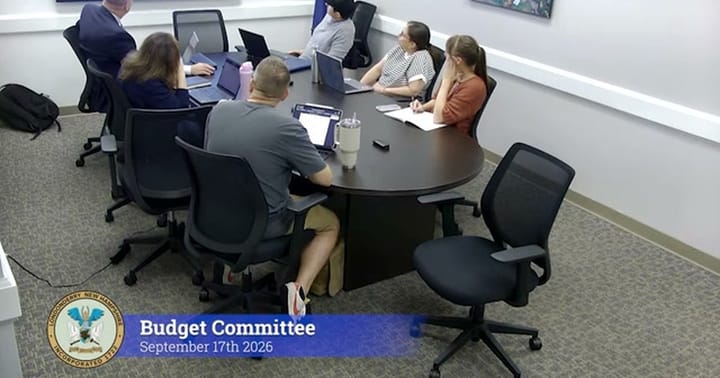
Budget Committee · Meeting of September 17, 2026
LONDONDERRY — The Londonderry Budget Committee voted unanimously to adopt new bylaws and heard Town Manager Shaun Mulholland project a $5.5 million annual net fiscal benefit from the proposed 1,028-unit Brookview Hollow development. Mulholland said legal spending is tracking at $475,000 against a $200,000 budget and could reach $900,000, calling it part of "way over budget for five years in a row." He also reported a 42 percent fire hydrant rental rate increase and a roughly $250,000 annual taxpayer subsidy for the town transfer station, which may move toward private operation. Chair Kate Burbidge and member Nicole Dery briefed colleagues on a state municipal association workshop, noting "it is, if there's no law, you cannot do it" regarding town budget authority.
The committee also approved August 20 minutes unanimously and scheduled October 15 tours of two fire stations.
In the full story:
- Who Was There
- Organizations And Documents Referenced
- The complete report — 2,388 words
Source: the Budget Committee meeting of September 17, 2026, reported from the official video recording and transcript.
Checked against the record: before publication this article was automatically compared with the meeting transcript.
The Full Article
PUD Fiscal Impact Presentation
The Brookview Hollow planned unit development has been in the pipeline for months, and the Budget Committee asked Town Manager Shaun Mulholland to walk through its fiscal numbers after he gave a broader PUD presentation to the committee roughly a month earlier. The question before the committee was not to approve or reject the project, which remains a Planning Board matter, but to understand whether the developer-prepared fiscal case holds up.
Mulholland presented a roughly 25-page fiscal impact report prepared by consultant Mark Fugere. The report calculated that Brookview Hollow's approximately 1,028 units would generate $7.8 million in annual revenue against $383,000 in municipal service costs (police, fire, solid waste) and $2.3 million in school costs, netting $5.5 million a year for the town. By comparison, the same parcel developed as roughly 200 single-family homes under existing zoning would net only about $946,000 annually, according to the report. Mulholland attributed the gap to density: spreading infrastructure costs, such as roads and utility lines, across more units lowers the per-unit tax burden needed to fund their eventual replacement. He cited "Urban3" fiscal density analyses the state has funded in Dover, Rochester and Portsmouth as a visual framework for the same argument.
Mulholland was clear that the analysis is incomplete. "It also doesn't take in a cost, the infrastructure improvements that are necessary to be able to allow development of this size to be absorbed in that neighborhood," he said, noting Brookview Hollow sits nine to 10 minutes from the nearest fire station, compared with a four-minute national response benchmark discussed at the meeting. He also described existing intersections near the site, including Pillsbury Road, as already operating at "level F" service, the worst traffic category, because a previous PUD, Woodmont, built along Route 102 without funding Pillsbury-area mitigation.
Much of the discussion turned to how the town collects developer contributions for traffic. Mulholland said he convened a working group earlier in the year, including Planning Board chair Tony Dio-Francisco and committee member Jeff Penta, to establish a consistent methodology for charging developers their "fair share" of mitigation when existing roads are already failing. The group identified roughly eight possible approaches but did not reach consensus, leaving Mulholland to negotiate case by case. "That's why it's taken months to negotiate the Procopio agreement," he said, referring to a separate pending development, adding that the deal must reach the Town Council packet by October 5 and that the developer must pay the town's negotiated contribution by October 30 or face a 5 percent inflation penalty on construction costs. The negotiated scope grew from a single right-turn lane proposal to four separate improvements, including stop signs and a future roundabout, plus easements for future construction.
On schools, Mulholland said fiscal impact models typically overestimate the number of children a PUD will generate, based on experience across multiple districts, and that any shortfall in school capacity at Londonderry's North School, which feeds both this project and the separate Villages at Technology Hill development, would likely require redistricting rather than new school construction. No vote was taken on any PUD-related item; the committee's role was informational.
Budget and Finance Workshop
Chair Kate Burbidge and member Nicole Dery summarized a New Hampshire Municipal Association workshop they attended the same day. Burbidge said the most useful distinction was between Londonderry's committee, which is advisory, and official budget committees elsewhere in the state that have statutory budget authority, including filing with the state Department of Revenue Administration. "It is, if there's no law, you cannot do it," Burbidge said, describing New Hampshire's constitutional structure, under which towns may act only where a specific statute authorizes it.
Burbidge also flagged that reducing a budget line is legally distinct from "zeroing out" the entire line: a zeroed line cannot later be replenished through a transfer, even if the town council and manager wanted to restore partial funding, while a reduced-but-nonzero line can still receive transferred funds from elsewhere in the budget. Dery added that Londonderry's own charter definition of a "default budget" differs from the statewide definition NHMA will cover in a free webinar on September 29. Both members said they would forward the NHMA presentation slides and a roughly 106-page budget reference book to the full committee, while noting most of its content applies to official, not advisory, budget committees.
Facility Tours
The committee has been touring town facilities throughout the year and had the library and fire department remaining before November budget hearings begin. Kate Burbidge reported that Deputy Fire Chief Phil LeBlanc advised that this weekend's fire department open house would not make for an adequate tour. After discussion of which facility carried more budget urgency, Jeff Penta noted the library's major renovation work is largely complete aside from exterior roofing and HVAC work covered by a planned $1.4 million bond question headed to March voters, while fire department Station 2 has pending work tied to an approximately $503,000 capital project and new rooftop solar expected within six weeks. The committee agreed to tour Station 2 and the Central Fire Station on October 15, skipping the third station to avoid repeating a prior two-and-a-half-hour, three-station tour, and dropped the library tour from the schedule for now.
FY2028 Budget Calendar and Meeting Format
Burbidge presented a color-coded calendar distinguishing meetings held jointly with the Town Council (orange), with the School Board (purple), and budget-committee-only sessions (green). The joint kickoff meeting is set for Saturday, November 7, covering the Town Manager's office, Police, Fire and DPW; additional department sessions follow November 10 and 17, covering departments such as the town clerk, tax collector, finance, assessing and HR. Burbidge proposed shifting the committee's own meetings to a 6:30 p.m. start, with the final 30 minutes of November sessions reserved for warrant article review, a change members supported. Mulholland said his office is advancing its budget calendar earlier than in past years and that department budget requests will be largely finalized by October 5, when warrant articles go before the Town Council, though the committee will not attend that particular session unless members choose to.
Liaison Reports
A committee member reported that the School Board had reviewed the potential impact of House Bill 1300, a proposed statewide tax cap that will appear on the ballot and would require approval both now and again in 2028 under a supermajority threshold. Non-mandated programs discussed as vulnerable include student transportation, Advanced Placement courses, athletics, electives and one-to-one student devices. Members noted a March citizen's petition on a similar local question drew 75 percent opposition in Londonderry, though the ballot measure's exact legislative language may differ from that petition.
Mulholland, filling in for an absent liaison, reported on Town Council and Town Hall business. The Police Department and Town Hall roofs are being replaced with solar installed on both buildings, and the new School Administrative Unit office building is tracking ahead of its original July completion target, now expected by March, delayed slightly by brick supply issues. He reported a staffing transition in the Planning Department: former Planning Director Kelly has departed, incoming Planning Director Jacob LaFontaine, currently planning director in the Town of Salem, starts October 8, and longtime staffer John Trottier is retiring after 25 years, with his last day the following Friday.
On the town's legal budget, Mulholland said spending is tracking at $475,000 against a $200,000 appropriation and could reach $900,000 depending on outstanding July and August invoices, continuing what he described as a five-year pattern of underbudgeting. "And it's been way over budget for five years in a row," he said, adding that prior town leadership, including former Town Manager Mike Malgoody, who Mulholland said was an attorney, kept the legal line at roughly $200,000 to $275,000 despite consistent overruns. He said the town retains five separate law firms for specialized matters and does not support hiring in-house counsel because the volume and diversity of legal work would be difficult to replicate internally.
A member reporting on DPW, citing conversations with staff identified only as Dave and James, said the department expects higher costs for salt, sand and fuel, an owner's project manager contract of about $150,000 covered through internal budget transfers rather than new appropriation, new uniform purchases following safety concerns with older cotton uniforms, and higher AutoCAD and Bluebeam software licensing costs. The same or another member reported that fire hydrant rental fees paid to the water provider will rise 42 percent, pushing the town's total hydrant rental cost toward roughly $1 million a year; Mulholland said he is pursuing an alternative in-house hydrant maintenance approach that could cost closer to $50,000 annually. Household hazardous waste and trash disposal costs may rise from about $2.2 million to $2.8 million.
Mulholland separately briefed the committee on the town's transfer station, which he said is subsidized by property taxpayers by about $250,000 a year because of low usage rates, limited hours and no winter operation. He cited a nearby Hudson Town RFP soliciting private operation as a possible model, estimating usage rates could rise sharply, by his estimate as much as 400 percent, under private operation, while service hours would likely improve. No decision was made; Mulholland said the Town Council will ultimately decide whether to pursue privatization.
On CIP, a member reported that all department project presentations have concluded and that prioritization of the roughly $175 million six-year capital list begins in coming weeks, covering public safety and DPW equipment, roads, water projects, a possible conversion of the town skate park to pickleball courts, and IT security and badging systems. On Fire, a member reported Station 2 work and solar installation are progressing, that a previously approved executive assistant position has freed up time for Deputy Chief LeBlanc, and that the department may request eight new firefighter/EMT positions, a fire inspector and a training officer, pending how a new Litchfield fire and ambulance service agreement affects staffing needs. On Police, a member reported no major budget changes and continuing efforts to address women's locker room capacity. On Planning Board, member Jeff Penta, filling in for absent member Matt Tapley, said he had not attended any Planning Board meetings that month. On Library, a member reported the renovated Leach Library has reopened, crediting Library Director Dawn and staff member Bob Slater, described as not a library official, for managing the project; circulation staff member Megan highlighted new carpeting with a waterproof backing designed to last the library's full 30-year renovation cycle.
Old Committee Business: Bylaws
The committee reviewed a clean copy of its bylaws incorporating prior edits from Mulholland. Member Nicole Dery noted the document states the secretary "shall sign the minutes," which does not match current practice of typing a prepared-by line rather than a physical signature; the committee did not amend the language at this meeting. Burbidge then called for a motion.
Procedural outcome: A motion was made and seconded to adopt the bylaws as presented. The motion passed by unanimous voice vote, with no discussion of amendments beyond the signature-language question raised and left unresolved.
Other Business: Onboarding Checklist and Minutes
The committee reviewed a draft new-member onboarding checklist, suggesting additions including links to past budgets, current FY2028 budget information, the NHMA budget book, future SharePoint access and mileage/parking reimbursement guidance using federal GSA rates. No vote was taken; Burbidge will revise the draft for a future vote. A motion to approve the August 20 meeting minutes was made, seconded, and passed unanimously.
Implications and Scheduling
The committee confirmed it will not meet September 24 as originally placed on its preliminary calendar, since warrant article materials are not ready. Its next meeting, October 15, will consist of tentative 6:30 p.m. tours of Fire Station 2 and the Central Fire Station, with no regular agenda items. Budget season formally begins with the November 7 joint Town Council session, with the committee's own sessions shifting to a 6:30 p.m. start on November 10 and 17 to accommodate dedicated warrant article discussion time.
Kate Burbidge, Chair, presided over the meeting. Nicole Dery, Member at Large, present; co-reported on the NHMA workshop. Jeff Penta, Member at Large, present; reported on Planning Board in Matt Tapley's absence. Rebecca Roe, Member at Large, present. Isaac Fernandez, Member at Large, present. Matt Tapley, Secretary, absent. Andria Hansen, Member at Large, absent. Shaun Mulholland, Town Manager, attended to present the PUD fiscal analysis and cover several liaison topics. No members of the public attended; public comment was not offered. Outside parties referenced but not present: Mark Fugere, fiscal consultant for the Brookview Hollow developer; Montaigne Builders, the developer; Tony Dio-Francisco, Planning Board chair, cited regarding a prior traffic-mitigation working group; Phil LeBlanc, Deputy Fire Chief, cited regarding fire tour scheduling; Jacob LaFontaine, incoming Planning Director; John Trottier, retiring town staffer; Dawn, Library Director; Megan, library circulation staff; Bob Slater, described as assisting the library renovation; Sherry Farrell, Town Clerk, referenced regarding reimbursement procedures; Chief Young, Fire Chief, referenced regarding staffing requests; Dave and James, DPW staff; Justin, referenced regarding reserve fund investments and DRA reporting; Mike Malgoody, former Town Manager, referenced historically regarding the legal budget.
Brookview Hollow fiscal impact report, prepared by consultant Mark Fugere for the developer — the central document for item 4.1, projecting $5.5 million in net annual municipal benefit. Montaigne Builders — developer negotiating the Pillsbury Road/Gilchrist Road traffic mitigation agreement referenced in the PUD discussion. Urban3 — a density/fiscal-impact analysis methodology cited by the Town Manager, previously applied in Dover, Rochester and Portsmouth, New Hampshire. Procopio Agreement — a pending developer traffic-mitigation agreement cited as requiring finalization before an October 5 Town Council deadline. House Bill 1300 — state legislation establishing a proposed municipal/school tax cap, discussed in the School Board liaison report. New Hampshire Municipal Association (NHMA) — hosted the budget and finance workshop attended by two committee members and is hosting a September 29 default-budget webinar. Town of Hudson RFP — cited by the Town Manager as a model for potential private operation of Londonderry's transfer station. 2026-09-17 BC Bylaws Clean Copy — the document adopted by committee vote at this meeting. Onboarding Checklist_BudCom_DRAFT — reviewed but not voted on; revisions requested. BC-minutes-2026-08-20.pdf — approved unanimously as the prior meeting's minutes.
Share this story
Know someone in Londonderry who follows town government? Share Townbrief Londonderry: they can sign up free.